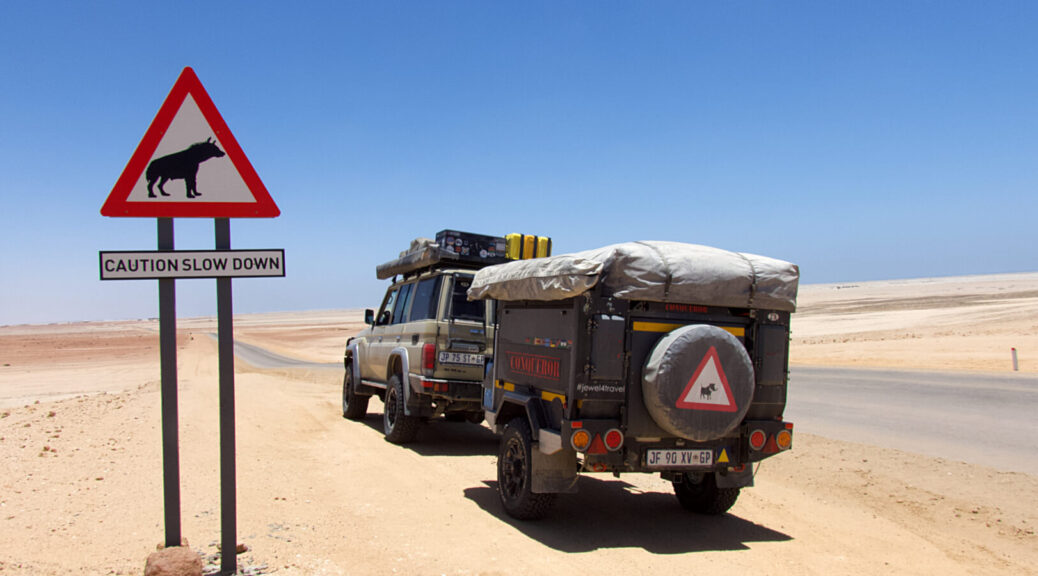
For overlanders, an off-road trailer or caravan brings both advantages and considerations. Renting one is a way to test what works best for you.
When it comes to overlanding as a way of travel, being adequately equipped is an evolving process. You might start with your day-to-day vehicle and whatever camping gear you can fit in the boot. Then, once the overlanding bug has properly bitten, a 4×4 rig with a rooftop tent is often the next step. Getting the vehicle kitted out with a storage system makes trips easier still. But for comfort and convenience at the end of a bumpy track, the ultimate solution could well be an off-road trailer.
The appeal of an off-road trailer
To build a vehicle-based overlanding rig comes at great cost and it tends to become a permanent fixture. While it is perfectly possible to have a well-equipped overlanding vehicle still serving as a daily drive for the family, there are negatives. Fitting a roof rack will increase the height of the vehicle, which becomes a consideration at the mall’s underground parking. Anything added onto the vehicle will also increase the weight which may lead to the next step, upgrading the suspension. The vehicle’s fuel consumption will also increase permanently.
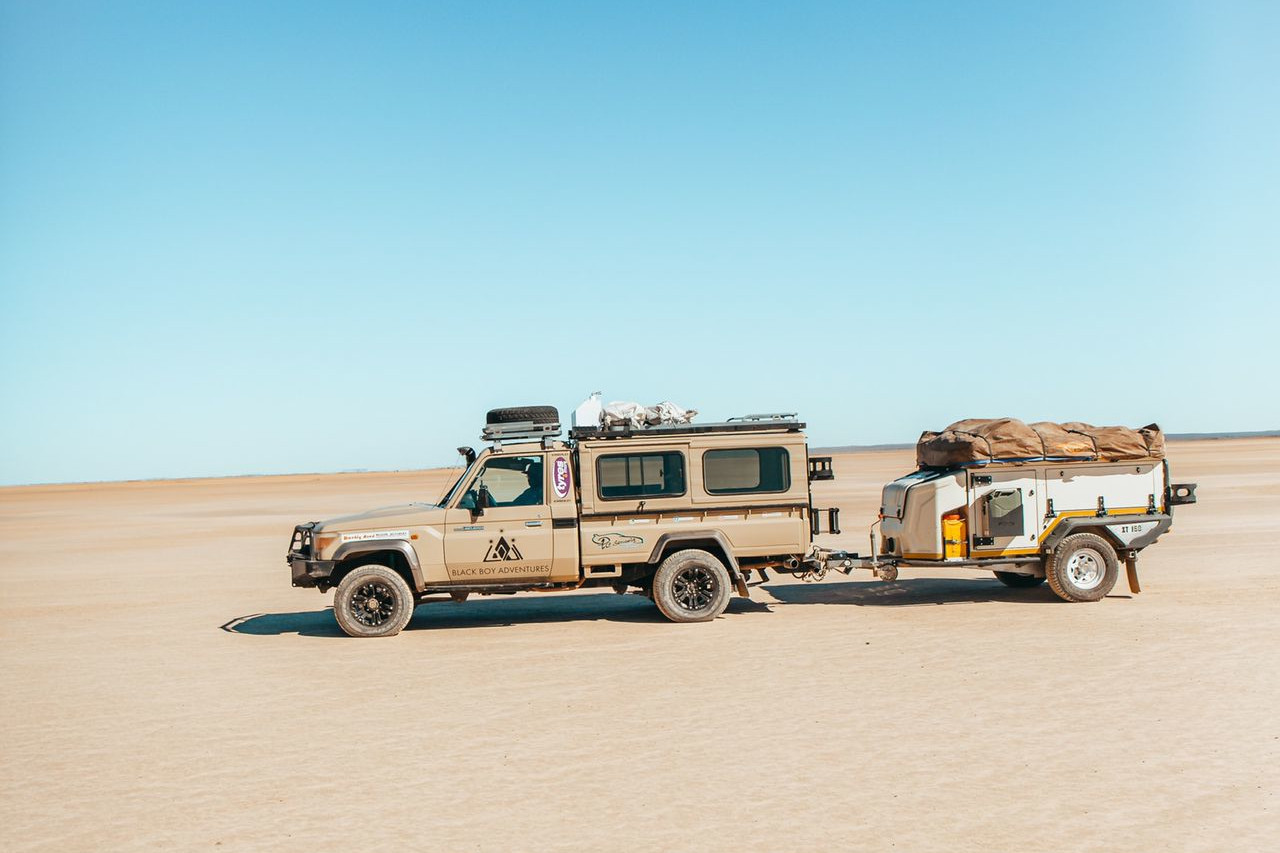
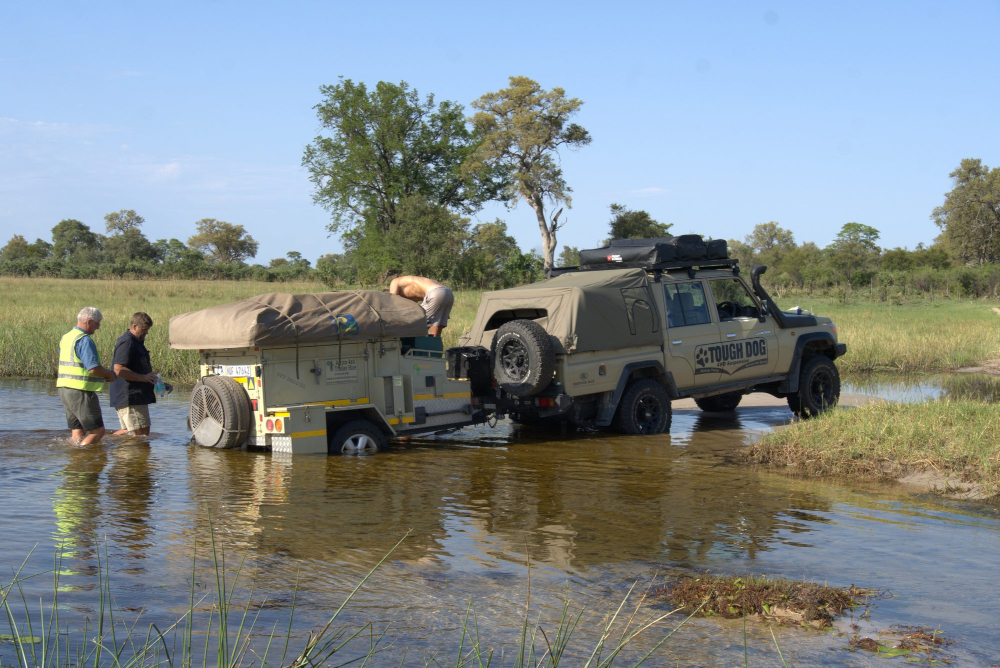
The allure of an offroad trailer or caravan is that you have a fully equipped camping rig, explains Tracks4Africa’s Johann Groenewald. He recently completed the Namakwa Eco Trail as one of four vehicles towing a bush caravan or camper. He says you can’t underestimate the value of things like a water tank, a geyser for hot water, lots of packing space and a good camping kitchen, not to mention a comfortable bed. Most of these rigs also have a battery system linked to solar that allows a fridge to be permanently used in the trailer or caravan. The downside is towing the trailer or caravan in technical terrain. But the added fuel consumption when towing is only slightly more than having the same vehicle fitted with a roof rack and roof top tent.
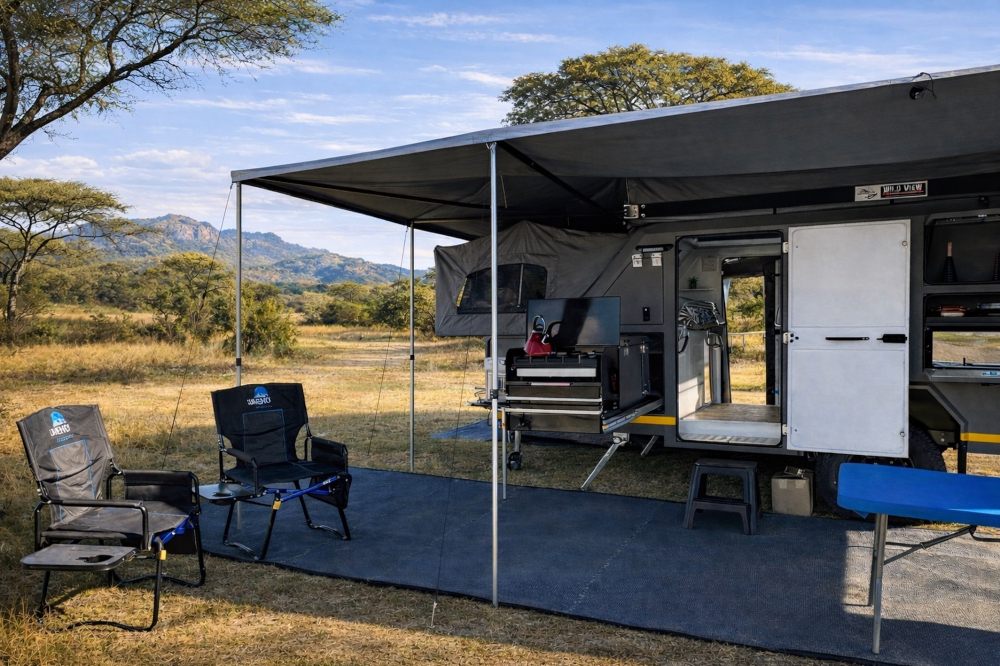
Thanks to a reinforced chassis, proper ground clearance and independent suspension, an off-road trailer can handle gravel roads that would shake a standard caravan apart. A trailer dramatically increases your packing space and keeps you from overloading your vehicle. Because it has storage for everything from utensils and food to clothes and camping chairs, it’s easy to find what you need and quick to set up camp. You can have a well-built off-road trailer ready for your stay in under 10 minutes. After a long day on the road, what could be better than popping the tent and putting your feet up?
A big investment
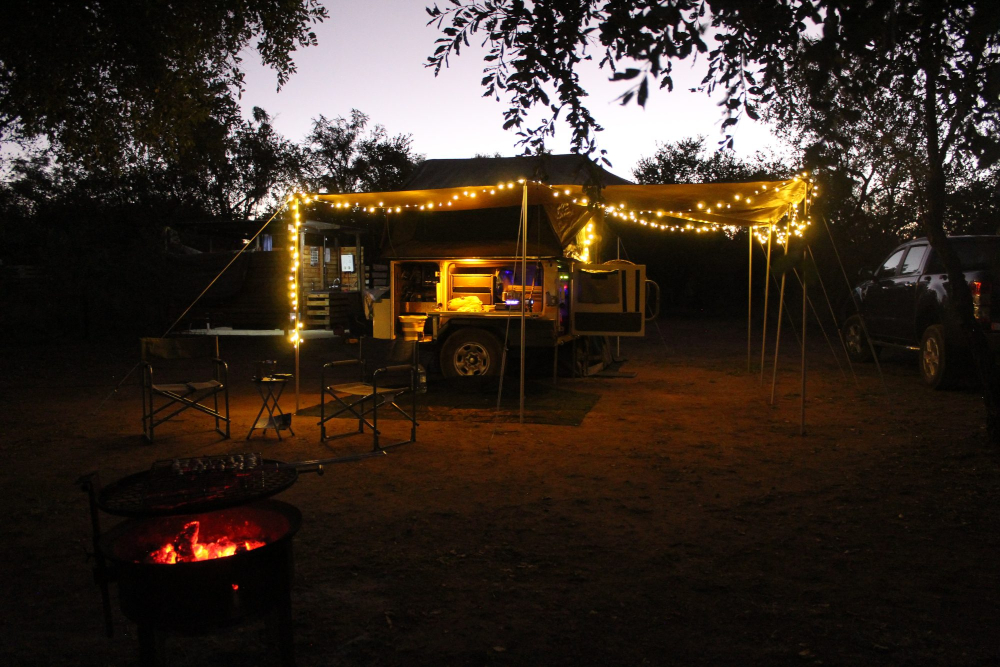
Sleeping dry and comfortably is a major benefit of towing an off-road trailer. But you’d be wise to remember that a trailer isn’t a house on wheels, it’s too compact for that. You will still be spending most of your time outside. Where it does shine is as a base camp. If you have a rooftop tent on your vehicle, you have to close things up every time you want to go for a game drive. A trailer you simply leave in camp.
We can debate the pros and cons of the various rigs at length but modern offroad trailers and caravans don’t really limit where you can go. Besides, the ease of camping often outweighs any limitations you may think of.
The downside of buying a trailer or caravan is the capital outlay that remains unused. If you do not have a safe place to store your trailer you may have to pay monthly storage as well.
If you’ve thought of getting an off-road trailer, but the price has been a stumbling block, consider renting one. There are businesses that rent out equipped off-road trailers, such as Go Camp and Conqueror (who build trailers themselves). A different option is Kampi.co.za, the website that lets you rent from private owners around the country.
“I realised there were thousands of caravans and trailers parked in driveways 45 weeks a year. And thousands of families who wanted to camp but could not justify buying one,” says JP Voogt, who co-founded Kampi.co.za in 2021. For this article, he provided some useful guidelines to help first-time trailer users.
Finding the right trailer for you
Before you book anything, it’s useful to think about exactly what you’re looking for in a trailer. Three questions can help you pin-point the one you need:
• Who is coming? A couple can get comfy in any size trailer. A young family will fit in a trailer with a rooftop tent and a kid tent below. Two couples travelling together will prefer a different layout to a family of four.
• Where are you going? Ask yourself if you’ll be doing decent gravel roads or if it is an expedition to the back of beyond. A trip to Marakele National Park isn’t the same as one bound for Khaudum National Park. If you plan on crossing the border, you need to rent a trailer that permits this.
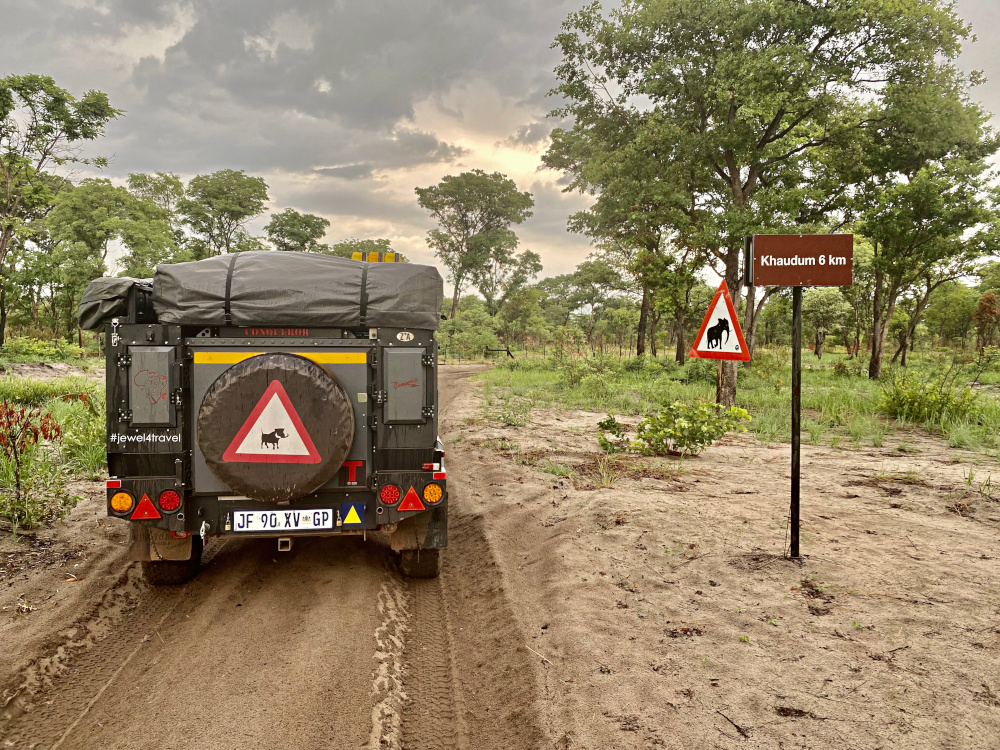
• How remote are you going and for how long? A weekend in the Cederberg is a different prospect to 10 nights in Botswana. Your destination and duration determine water capacity, battery, solar power, fridge size and fuel range. “Pick the trailer to match the worst night of the trip, not the best,” suggests JP.
What you need to know about towing
Overlanding with a trailer isn’t just a case of hitching it to your vehicle. There are considerations to make sure you can safely tow it.
Licence
If you want to tow anything over 750kg GVM (effectively the maximum total mass), you need a Code EB licence, not code B. The reality is that the majority of off-road trailers exceed 750kg loaded. If you got your licence before 2000, the old Code 08 converted to EB automatically. Check your licence before renting a trailer. If you tow without the valid permission, you can get a fine and your insurance declared void. Learn more about towing and licence requirements.
Tow vehicle match
The manufacturer’s tow rating on your bakkie is not a suggestion and may be enforced at weighbridges. Check braked vs unbraked rating, nose weight (7–10% of trailer GVM on the ball), and whether your service plan covers towing. If your tow vehicle is stock standard you may also want to consider where you tow. In deep sand, for instance, the ‘middelmannetjie’ may cause a heavily laden tow vehicle to drag its belly on the sand and you will definitely get stuck.
Trailer charge
Another consideration is if the trailer requires the battery system to be charged from your vehicle. To be able to do this you require a special charging point to be installed at the rear of your vehicle and this may not be worth the cost for a once-off trip. The power source for the battery system would then need to come from either solar or shore power at the camp. The battery would require sufficient capacity to run the fridge during the day when towing.
Fuel use
Your fuel consumption, when towing, will be a lot more than your normal commute. Figures will vary depending on the weight and size of the trailer or caravan as well as your driving style, but factor in at least a 30% increase when calculating your fuel range. If you have the chance, do a test run.
Brakes and safety chain
Trailers over 750kg must have their own brakes (override or electric). In South Africa, the safety chain is law. “Cross the chains under the coupling, do not run them straight,” advises JP. “If the coupling ever drops, crossed chains cradle the drawbar. Straight chains let it dig into the tar at speed.”
Questions to ask the owner
Before you pay a cent or set off on your long-distance adventure, get the necessary answers. JP recommends asking these questions:
- Has this trailer been on gravel recently? Some trailers list as off-road but have only ever seen tar. You want one that has been to Kgalagadi or the Baviaanskloof and come back clean.
- What is the GVM loaded and unloaded? You need this to match your tow rating. If the owner doesn’t know, that tells you something.
- What is included? This could include bedding, pots, kettle, braai grid, gas bottle (full or empty), water tanks (clean), solar power, inverter, fridge. Get it in writing in the listing chat so it is on record.
- Date of tyre change, brake fitment, last service? Ask when the wheel bearings were last repacked. A trailer that tows 1,000km to the starting point needs bearings that are not on borrowed time.
- Cross-border papers? Botswana, Namibia and Mozambique all require a police clearance letter, ZA sticker and the owner’s ID on the papers. Ask upfront – this isn’t a conversation to have at the border. Note that not every owner has the papers ready or will permit cross-border trips.
- Power budget? If the fridge draws 40Ah a day and the battery is 100Ah with no solar, you have a problem by night three. Owners who run their own trailers know these numbers cold. Trailers with different setups are fine, but you need to plan accordingly.
- What is fiddly on this trailer? The honest owners will tell you. A quirky water pump, a door that sticks, a light that flickers. Better to know at handover than at Augrabies Falls.
Traveller tips
Once you’ve decided to rent a trailer, these guidelines will make your expedition easier.
- Plan fuel and water stops like your life depends on them. In the Kalahari, the next settlement is not as close as you think it is. And even when the distance isn’t great, it could take much longer than you imagine. Tracks4Africa paper maps clearly show distance and travel times, as well as traveller services, for just this reason.
- “Do a shakedown night,” suggests JP. If you have rented an unfamiliar trailer for a big expedition, spend one night at a campsite near a major town first. Find the problems where you can still easily fix them. Better still, rent the trailer beforehand for a weekend trip to a serviced camp where you can test everything out.
- For gravel roads, drop tyre pressure on both the tow vehicle and the trailer. Tracks4Africa suggests: For gravel roads, deflate roughly 20% of your normal tyre pressure on the tow vehicle and 40% in deep sand. If you still struggle with traction, then go down even more but do not go below 1bar unless you have experience in resetting a tyre that came off the rim. You may also want to keep the rear tyres at a higher pressure since these are taking the weight of the trailer when going through bumps in the road. If you drive in rocky terrain, you want enough air in the tyre to compensate for driving over rocks. For the trailer, you can do the same percentages but pay attention to the type of tyres fitted.
Carry a proper compressor to reinflate when you get back to tar or harder surfaces. - Take it slowly. When you hit corrugations at 80km/h, things shake loose and wheel bearings wear out. At 40km/h, the impact is much less, so in the long run, you save time by slowing down.
- Stop regularly to check that everything is still where it was when you set off. Feel the trailer hubs with your hand. If they are smoking hot or the left and right are vastly different, you have a problem. Check the wheel nuts when you receive the trailer. Make sure the spare is in good shape and that you have the correct wheel spanner to change the wheel.
- Arrive in daylight. Setting up an unfamiliar off-road trailer in the dark is how relationships get tested, says JP.
About booking through Kampi
On Kampi.co.za, you can search by camper type, dates and location, then put in a booking request with the owner. The owner has 48 hours to approve or decline, after which you pay the rental fee and get details for collection. Kampi provides insurance at R89 a day, plus 24/7 roadside assistance.
